Wednesday, April 18, 2007

Scientists Create Molecule-Size Keypad Lock

Israeli scientists have come up with the ultimate in small-scale security:, a molecule that can act as an electronic keypad lock like the ones in home security. This process give new heights to small scale safety measures and has the potential of providing unbreakable security. The molecule lock, resembling an iron binding compound secreted by special bacteria, ‘unlocks’ when exposed to a smart combination of two chemicals and UV Light, giving out florescence as a signal. The molecule consists of pyrene and fluorescein linked by an iron-binding segment. The molecule lights up green or blue in response to the correct passwords and fluoresces dimly if the same inputs are introduced in a different order(wrong password). Moreover, the molecule would lock-up upon failed retries and block any further attempts at breaking it.


As acid, base, and irradiating UV light are introduced at three minute intervals, the molecule jumps between various charged states. The result, report researchers at the Weizmann Institute, Rehovot, is that the sequence ‘acid-base-light’ makes the molecule fluoresce green, while a separate input ‘acid-light’ gives a blue fluorescence. Any other sequence input gives dim light or none at all. This behaviour, says co-author Abraham Shanzer, mimics an electronic keypad lock. The device lights up only when the correct chemical ‘passwords’ are introduced.
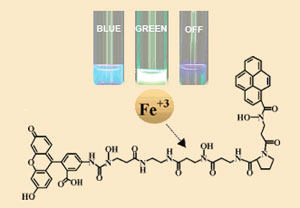

Basic Molecule Structure
"By harnessing the principles of molecular Boolean logic, we have designed a molecular device that mimics the operation of an electronic keypad, a common security circuit used for numerous applications in which access to an object or data is to be restricted to a limited number of persons," the researchers state. "The development of a molecular-scale keypad lock is a particularly attractive goal as it represents a new approach to protecting information at the molecular scale."


How the molecular keypad lock works

A significant application to this lock might be to recognize when certain sequences of chemicals are released in the body—for instance, after exposure to Sarin or another deadly chemical including various biological weapons and allow safeguard triggers.


Note: This story has been adapted from a news release issued by American Chemical Society, Science Daily, Live Science and Scientific American.

Tuesday, March 27, 2007

Citing Wikipedia? Read this first…


Are you a wiki fan? Do you have the compulsive nature of automatically going for wikipidia?org when u want to know about anything? Are you amused by the top bunks that wiki occupies in Google search results? If yes then u need to understand the dual nature of information presented on wikipedia.
Lets first understand how Wikipedia get all that information? It is an open community encyclopedia that can be edited by anyone? Other then the rules of well formed structure, it does not tell us what not to write and how to define things. So it becomes very possible that a user writes or edits a topic on which he is not an expert or the user thinks that he has the correct information. Since there is no authority to validate that information, it becomes a very real possibility for the published information to be incorrect. But from the view of a user of that information, the popularity and enormity of the wiki foundation makes it easy to believe that the contained information is correct. Thus, the information looses credibility and becomes contradictory with the concept of citation. For a primer here are a few excerpts for the web-

History Department Bans Citing Wikipedia as a Research Source
By NOAM COHEN Published in New York Times, February 21, 2007

Dr. Waters and other professors in the history department at Middlebury College had begun noticing about a year ago that students were citing Wikipedia as a source in their papers. But the errors on the Japanese history test last semester were the last straw. At Dr. Waters’s urging, the Middlebury history department notified its students this month that Wikipedia could not be cited in papers or exams, and that students could not “point to Wikipedia or any similar source that may appear in the future to escape the consequences of errors.”


Referencing Wikipedia? Use Caution
By Kevin Garcia (The Brownsville Herald ) January 24, 2007

To many, Wikipedia is a godsend. It's a way to find information on any topic quickly and easily. What some fail to realize, however, is that nothing on the Web site can be taken at face value. Anyone, from age 8 to 80, from a high school dropout to a rogue scholar, can edit the online encyclopedia. Wikipedia can actually be a good source of information. It can lead people to any number of ideas that they might never have considered. That's the beauty of mass media. What Wikipedia is not, however, is a credible source.


When it comes to Computer Science, don't reference Wikipedia
by Christopher Diggins written July 31, 2005

This is not the first time a Wikipedia computer-science definition has made me want to pull my hair out. In the end I don't care, as long as people don't make the mistake of taking Wikipedia definitions seriously. Just remember that in Wikipedia the definitions are written by random people, and edited by random people, not experts.


  • It is not all bad, wiki is a very good source for information about any topic. But considering it’s use as a credible source of information is not good. There are many more such articles that advice people not to use Wikipedia for citation and every user should try and find a credible source for information for such purposed.

Friday, March 23, 2007

A take on C++ by its creator Bjarne Stroustrup

Wow, I mean simply wow. Today a friend(Amardeep) IMed me a link to a leaked interview(taken on 1st Jan 1998 and never published), supposedly with Bjarne Stroustrup, the creator of then C++ programming language. The language that changed the world of programming and software engineers. When I was in college I was attracted to the world of computers and c++ gave me the way to actually contribute to the IT world. It created the base for me to understand how a computer works and how I can customize it to my liking.

In this interview with Stroustrup, the reporter thought he would get a retrospective view of the revolutionary programming language Stroustrup had created but instead by the end of the interview he was boggled. Stroustrup, unfortunately, had a very different take on his effort and went on to say that c++ was actually the result of a scheme he conjured up one day because he thought that the present programming languages were actually demeaning the importance of programmers by being too easy to learn!

Stroustrup thought that in the beginning programmers were royalty and had huge salaries but since earlier programming languages were easy enough to be learned by anyone, it resulted in too many programmers thus dropping the status of programmers as a 'demi-god'. So, he went on to create a programming language that was so insanely complex that most people would not be able to learn it and the few who did would stay high up in the software industry food chain.

To better explain his point of view here are a few quotes by Stroustrup from the interview-

"Well, in the beginning, these guys were like demi-gods. Their salaries were high, and they were treated like royalty."

"Well, one day, when I was sitting in my office, I thought of this little scheme, which would redress the balance a little. I thought 'I wonder what would happen, if there were a language so complicated, so difficult to learn, that nobody would ever be able to swamp the market with programmers? Actually, I got some of the ideas from X10, you know, X windows. That was such a bitch of a graphics system, that it only just ran on those Sun 3/60 things. They had all the ingredients for what I wanted. A really ridiculously complex syntax, obscure functions, and pseudo-OO structure. Even now, nobody writes raw X-windows code. Motif is the only way to go if you want to retain your sanity."

"Well, it's been long enough, now, and I believe most people have figured out for themselves that C++ is a waste of time but, I must say, it's taken them a lot longer than I thought it would."

"It was only supposed to be a joke, I never thought people would take the book seriously. Anyone with half a brain can see that object-oriented programming is counter-intuitive, illogical and inefficient."

Later he goes on explaining the 'illogical and un-important' features like operator overloading, executable size, typedefs, inheritance etc. Oh and did i say what he felt about C++ when he finished working on it he said, "Hated it. It even looks clumsy, don't you agree? But when the book royalties started to come in... well, you get the picture."

To tell u the truth I really hated this kind of response from Stroustrup, who was one of my computing childhood heroes। How often has it been said that never come face to face with your childhood hero if you want them to say an inspiration। In the end I would like to believe that this interview is not true but a search on Google says otherwise and that you should not believe everything you read.
See full interview here or here.